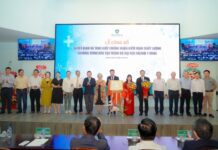

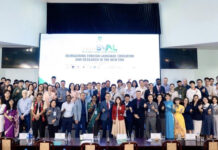
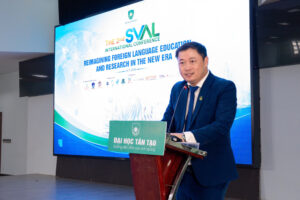
On November 14, 2026, Tan Tao University (TTU) hosted the 2nd International Scientific Conference on Foreign Language Education and Research (SVAL2 – 2026), themed “Reimagining Foreign Language Education and Research in the New Era”. The event brought together a large number of domestic and international scholars, lecturers, experts, and researchers, providing an academic platform for exchanging ideas on emerging trends in language teaching, learning, and research, particularly the application of artificial intelligence (AI) in education.

Connecting Domestic and International Academic Networks
The conference was held at Tan Tao University (TTU) and co-organized by Ho Chi Minh City University of Economics and Finance (UEF), Nguyen Tat Thanh University (NTTU), and Binh Duong University (BDU). The program received academic support from the Ho Chi Minh City Association of English Language Teaching and Research (TESOL HCMC), along with Foreign Language Faculties from various universities.
In addition, the conference received in-kind sponsorship from five reputable educational brands: FAHASA, National Geographic Learning (NGL), Macmillan Education, Horizon TESOL, and HeyHi.
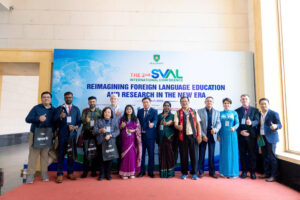
The event was attended by representatives of the Boards of Rectors of Tan Tao University, Ho Chi Minh City University of Economics and Finance, Nguyen Tat Thanh University, Binh Duong University, and Ho Chi Minh City University of Foreign Languages and Information Technology, alongside a large number of domestic and international lecturers, experts, and scholars. Notably, speakers joined from the United States, India, Thailand, Australia, Singapore, and many other countries.
In his opening remarks, Dr. Nguyen Mai Lam, Rector of Tan Tao University, emphasized the importance of anticipating digital transformation trends and integrating artificial intelligence into research activities and innovative foreign language teaching methodologies. These are also key directions for improving educational quality and meeting the demand for human resource development in the context of international integration.
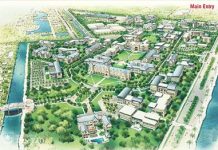
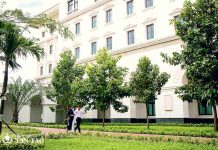
As the host institution, TTU placed particular emphasis on preparing its facilities and academic spaces to facilitate presentations, discussions, and professional networking. At the same time, the University’s development of multidisciplinary foreign language programs, including English, Chinese, and Korean at both undergraduate and postgraduate levels, reflects its commitment to expanding language learning opportunities and strengthening students’ international competencies.
More Than 130 Research Papers and 54 Domestic and International Institutions Participate
SVAL2 – 2026 attracted widespread interest from the academic community, featuring more than 130 research papers presented in five languages: English, Chinese, Korean, Japanese, and Vietnamese, with English accounting for approximately 80% of the submissions. The conference welcomed participation from 54 institutions, including 12 international organizations from countries such as the United States, India, Thailand, Australia, Singapore, and many others.
The research papers covered a wide range of topics related to language education, including innovations in teaching methodologies, technology applications, assessment and evaluation, curriculum research, and the development of language competencies in multicultural environments.
Notably, all academic papers underwent a peer-review process conducted by the Academic Committee before being considered for publication. Outstanding papers were given the opportunity to be featured in reputable academic publications, including Arab World English Journal (Scopus Q1), Traduction et Langues (Scopus Q2), the International Scientific Conference Proceedings published by the Vietnam Institute of Social Sciences Publishing House, and a special issue of the Tan Tao University Journal of Science (TJS).
Plenary Session: Key Issues in Education and Research in the AI Era
The academic program opened with a plenary session featuring two keynote presentations addressing timely issues in higher education and scientific research.
The first presentation, titled “Building a Sustainable Scholarly Publishing Career in the AI Era,” was delivered by Dr. John R. Baker from Ho Chi Minh City University of Industry and Trade. The presentation focused on establishing a strategic direction for sustainable scholarly publishing amid the significant changes artificial intelligence is bringing to research processes and knowledge production.
Following this, the presentation “Rethinking English-Medium Instruction (EMI) in Vietnamese Universities in the Digital Era” was delivered by Dr. Dang Thanh Nhon, representing the research team from Tan Tao University. The presentation raised important issues concerning innovations in English-Medium Instruction methodologies in response to the requirements of digital transformation in higher education.
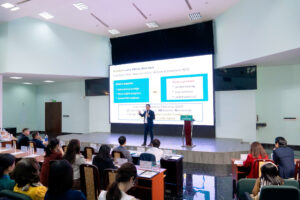
Together, the two presentations offered complementary perspectives, ranging from developing research and scholarly publishing capabilities to innovating educational practices. They also suggested approaches that educational institutions can adopt to meet the evolving demands of the current educational landscape.
Five Specialized Parallel Sessions: Diverse Perspectives on Language Research
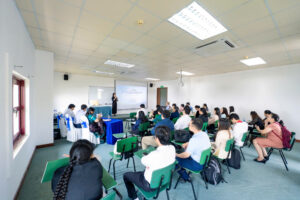
Following the plenary session, the conference organized five parallel sessions focusing on key professional issues in language teaching, learning, and research.
The sessions covered the following topics:
- AI-Powered Language Learning and Personalized Instruction: Exploring the potential of AI applications in supporting learners and adapting learning content and methods to individual needs and abilities.
- AI Integration in Teaching and Learning: Discussing the integration of artificial intelligence tools into teaching and learning activities while exploring new approaches to educational activity design.
- Assessment, Ethics & Quality Assurance: Addressing innovations in learner assessment, the maintenance of academic integrity, and the assurance of educational quality amid rapid technological development.
- Research, Curriculum Design & Intercultural Competence in the New Era: Focusing on curriculum development aligned with practical demands while emphasizing communication and adaptability in multicultural environments.
- Chinese, Korean and Japanese Teaching, Learning and Research: Expanding academic discussions to Asian languages by sharing issues and research directions in the teaching and learning of these languages.
Through these parallel sessions, language education issues were examined from multiple perspectives, extending beyond technological applications to address educational quality, academic standards, and the role of people in the learning process. In particular, dedicating a separate session to Chinese, Korean, and Japanese demonstrated the conference’s expanded research scope and reflected the growing demand for multilingual education amid international exchange and cooperation.
Promoting Collaboration and Shaping the Future of Language Education
Concluding a full day of academic activities, SVAL2 – 2026 reaffirmed its role as a platform connecting researchers, lecturers, and educational institutions in the field of languages. The presentations and discussions contributed to updating research trends, broadening professional perspectives, and creating opportunities for future collaboration in education and scholarly publishing.
For Tan Tao University, hosting SVAL2 – 2026 not only strengthened connections with domestic and international educational institutions but also demonstrated the University’s commitment to promoting scientific research, educational innovation, and the application of technology in language education.
Through the SVAL conference series, TTU continues to work alongside the academic community in seeking innovative solutions for teaching and research, contributing to the goal of making English a second language in schools while enhancing the quality of language education in Vietnam in the context of international integration.