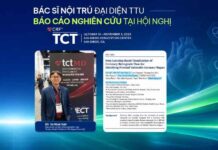

Recently, a research project conducted by the Faculty of Medicine at Tan Tao University (TTU), entitled “Application of Artificial Intelligence in Coronary Blood Flow Analysis,” was presented at TCT 2026 by Dr. Vo Minh Viet, a resident physician at Trinity Health (USA) and an alumnus of the first cohort of TTU’s General Medicine program, on behalf of the research team.
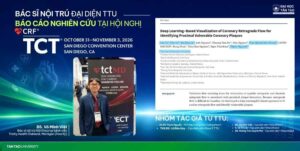
TCT 2026 – A GLOBAL FORUM FOR ADVANCEMENTS IN INTERVENTIONAL CARDIOLOGY
Held from October 31 to November 3, 2026, in San Diego, USA, TCT 2026 marked the 38th annual scientific symposium organized by the Cardiovascular Research Foundation (CRF). It is recognized as one of the world’s leading specialized scientific forums in interventional cardiology, bringing together physicians, specialists, researchers, and representatives of healthcare organizations from numerous countries.
Beyond providing updates on advanced interventional techniques and treatment approaches, TCT also serves as a platform for scientists to exchange new findings, introduce technology-driven approaches, and discuss the potential translation of research outcomes into clinical practice. The presentation of a research project involving TTU faculty members, physicians, and alumni at this conference represents a noteworthy milestone in the University’s research activities and international academic engagement.
APPLYING DEEP LEARNING TO IDENTIFY RETROGRADE FLOW – A NEW APPROACH TO RESEARCH ON CORONARY ARTERY DISEASE
The research, assigned abstract number TCT-1011, is entitled “Deep Learning-Based Visualization of Coronary Retrograde Flow for Identifying Proximal Vulnerable Coronary Plaques.” Its abstract was published in the Supplement of the Journal of the American College of Cardiology (JACC), Volume 88, Issue 18, 2026.
A key aspect of this research is the application of artificial intelligence to analyze a complex hemodynamic feature of the coronary arteries: retrograde flow. This phenomenon involves the interaction between backward blood flow during systole and forward blood flow during diastole. Changes in flow characteristics may be associated with the formation and progression of atherosclerotic plaques, particularly in the proximal segments of the coronary arteries.
However, identifying and assessing this flow pattern using conventional coronary angiographic images is not straightforward. To address this challenge, the research team applied a Deep Learning model to segment coronary artery structures, analyze contrast agent changes across consecutive frames, and generate heatmaps to visualize areas exhibiting retrograde flow or contrast stagnation.
The study was conducted on 48 patients with unstable angina. Coronary angiographic images were acquired at a rate of 15 frames per second and subsequently processed by an analytical system to evaluate the temporal movement of contrast agents.
The research findings revealed that:
- 83.3% of patients were identified as exhibiting retrograde flow through image analysis and heatmaps generated by the Deep Learning model.
- 75.2% of lesion sites were found to overlap with areas where retrograde flow was detected.
- Statistical analysis demonstrated a significant association between retrograde flow and the severity of coronary artery lesions (p<0.05).
These findings highlight the potential of combining Deep Learning with coronary angiographic imaging to analyze hemodynamic characteristics and identify areas at risk of lesions. Rather than simply observing images at individual time points, this approach also examines changes in contrast agent movement across consecutive frames, thereby introducing an additional method of image data analysis in coronary artery disease research.
Although further validation through larger-scale studies is needed, these preliminary findings suggest a promising direction for applying artificial intelligence in cardiovascular medicine. In this context, technology serves as a tool to support physicians in extracting and interpreting clinical data, contributing to the expansion of research methodologies and approaches to cardiovascular disease assessment.
RESEARCH CONTRIBUTIONS FROM TTU PHYSICIANS, FACULTY MEMBERS, AND ALUMNI
An important contribution of this research lies in the collaboration among practicing physicians, faculty members, and TTU alumni. Each member brings distinct professional experience and research perspectives, contributing to an interdisciplinary topic at the intersection of medicine, technology, and artificial intelligence.
Prof. Dr. Thach Nguyen – Vice President and Dean of the Faculty of Medicine, TTU
Prof. Dr. Thach Nguyen is an experienced specialist in cardiology and interventional cardiology, with a professional and research career closely connected to the international medical community. He has extensive experience in clinical research, cardiovascular specialty development, and fostering academic connections between domestic healthcare professionals and international experts.
In his capacity as Vice President and Dean of the Faculty of Medicine at TTU, Professor Nguyen contributes to shaping the University’s professional development strategies, promoting research activities, and connecting faculty members and physicians with academic networks. His involvement in this research also reflects the role of academic leadership in supporting research initiatives and creating opportunities for practical medical challenges to be explored through scientific approaches.
Dr. Vo Minh Viet – Alumnus of the First Cohort of TTU’s General Medicine Program
As one of the first graduates of TTU’s General Medicine program, Dr. Vo Minh Viet has spent more than a decade pursuing his professional career in medicine. Following his studies, passing the United States Medical Licensing Examination (USMLE), and meeting the requirements of the U.S. medical training system, he is currently a resident physician at Trinity Health in the United States.
In 2024, Dr. Viet presented a scientific paper at the 8th Bi-Neurovascular Symposium (BNS 2024) in South Korea. His research, entitled “Clinical and Paraclinical Correlates of Neurological Recovery in Acute Ischemic Stroke Patients Undergoing Reperfusion Therapy,” examined clinical and paraclinical factors associated with neurological recovery in patients with acute ischemic stroke undergoing reperfusion therapy. He also received a USD 1,000 grant from Hyundai to support his participation and presentation at the international conference.
His continued involvement in the research on coronary blood flow at TCT 2026 demonstrates his initiative in expanding research activities and professional collaboration, while marking another milestone in the academic journey of a TTU alumnus.
Dr. Vu Tri Loc – Faculty Member, Faculty of Medicine, TTU
After graduating from TTU’s General Medicine program, Dr. Vu Tri Loc continued to pursue research and currently serves as a faculty member at the University’s Faculty of Medicine. He completed the Global Clinical Scholars Research Training program at Harvard Medical School, an advanced training program in clinical research methodology covering the entire process, from identifying research questions and developing proposals to designing and conducting studies.
Dr. Loc’s research interests focus on coronary artery physiology, hemodynamics, and the application of artificial intelligence in cardiovascular imaging. In 2023, his research on Coronary Slow Flow in patients with Takotsubo syndrome earned him the Paul Dudley White International Scholar Award at the American Heart Association (AHA) Scientific Sessions.
In addition to his research and teaching activities, Dr. Loc participates in international professional networks, including activities associated with the AHA Council on Clinical Cardiology and the Cardiovascular Research Foundation. In 2026, he continued his academic engagement through the Inflammation Academy of the International Atherosclerosis Society and served as a Senior Collaborator in the Global Burden of Disease program.
MSc. MD. Le Bao Huy – Alumnus of the Faculty of Medicine, TTU
Dr. Hoang Truc Quynh Mai – Alumna of the Sixth Cohort of TTU’s Faculty of Medicine
Dr. Hoang Truc Quynh Mai has also participated in research activities and previously presented scientific findings at the Bi-Neurovascular Symposium. Her continued involvement as a co-author of the research presented at TCT 2026 marks another milestone in her academic journey after graduation, while highlighting the contributions of TTU alumni to research activities and professional collaboration with faculty members and physicians.
STRENGTHENING RESEARCH CAPACITY THROUGH INTERNATIONAL ACADEMIC COLLABORATION
Building on the preliminary findings of this research, the team has additional grounds to further investigate the relationship between coronary blood flow characteristics and atherosclerotic lesions, while evaluating the potential application of Deep Learning in cardiovascular image analysis. This research direction also demonstrates the potential of integrating clinical knowledge with technology to extract deeper insights from data already available through medical examinations and treatment processes.
The research project conducted by faculty members and students of TTU’s Faculty of Medicine and presented at TCT 2026 not only marks the professional growth of its participants but also highlights the close collaboration between faculty members and students in scientific research. It further demonstrates the University’s commitment to connecting education, clinical practice, and research, while creating additional momentum for TTU to develop an academic environment where learners can work alongside faculty members, explore new knowledge, and contribute to the advancement of medical science.