
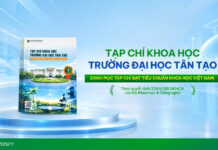

The Tan Tao University Journal of Science (TJS) has officially published Volume 01 – Issue 03, bringing the total number of scientific articles published across its first three issues to 34. Notably, its inclusion in the 2026 List of Vietnamese Scientific Standard Journals marks an important milestone in the University’s efforts to standardize its publishing activities and enhance its academic reputation.
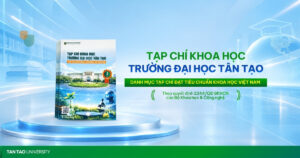
The Tan Tao University Journal of Science has completed the publication process and officially released Volume 01 – Issue 03, continuing to provide readers and the academic community with research across various scientific disciplines. Since its launch in March 2026, the Journal has maintained a regular quarterly publication schedule, with three consecutive issues released in March, June, and September.
In pursuit of the standards of a scholarly publication, TJS prioritizes articles written in English while emphasizing an independent, objective, and rigorous peer-review process. Through these efforts, the Journal is gradually establishing a quality academic platform that connects researchers and scholars from Vietnam and around the world. Meanwhile, the manuscript submission and peer-review process for the December 2026 issue is also underway as scheduled.
Notably, the Tan Tao University Journal of Science has officially been included in the 2026 List of Vietnamese Scientific Standard Journals, pursuant to Decision No. 2244/QD-BKHCN issued by the Ministry of Science and Technology. Of particular significance, TJS is the only scientific journal in Tay Ninh Province included in this list in 2026. This important milestone recognizes the University’s efforts to standardize its editorial, management, and scientific publishing processes. It also provides a foundation for the Journal to further enhance its content quality, expand its network of peer reviewers, and progressively work toward inclusion in international citation databases.
Another notable achievement in the Journal’s publishing activities is that 100% of the articles published in TJS’s first three issues have been assigned Digital Object Identifiers (DOIs), bringing the total to 34 articles. A DOI is a unique identifier assigned to each scholarly article, enabling readers to easily search for and access publications while helping authors cite references accurately. Even if an article’s storage location changes, its DOI link can still direct readers to the corresponding publication, provided that the associated information is properly updated. The consistent implementation of DOIs helps standardize publishing metadata, improve connectivity and citation tracking, and create opportunities for TJS publications to reach a wider international academic audience.
34 SCIENTIFIC ARTICLES PUBLISHED ACROSS THE FIRST THREE ISSUES
Across its three issues published in March, June, and September 2026, TJS has published a total of 34 scientific articles. Issue 01 featured 11 articles, Issue 02 included 11 articles, and Issue 03 contained 12 articles. Based on their primary research areas, these articles are classified into four main subject groups: Medicine and Health Sciences; Education, Languages and Culture; Applied Biology and Agriculture; and Economics, Management and Finance.
Specifically, Medicine and Health Sciences accounted for 13 articles, representing 38.2% of the total. Education, Languages and Culture also contributed 13 articles, equivalent to 38.2%. Meanwhile, Economics, Management and Finance recorded 5 articles, accounting for 14.7%, while Applied Biology and Agriculture included 3 articles, representing 8.8%.
In the first issue, Medicine and Health Sciences was the leading research area, with 7 out of 11 articles, equivalent to 63.6%. These studies focused on topics such as cardiovascular diseases, stroke, surgery, and nutrition, reflecting an interest in practical issues related to healthcare and health protection.
By Issue 02, the scope of published research had expanded, with three articles in Applied Biology and Agriculture addressing topics such as plant bioactive compounds, irradiation, and crop characteristics. In addition, the issue featured research related to digital marketing and the application of artificial intelligence (AI) in healthcare and education, highlighting growing interest in the role of technology across professional fields.
Meanwhile, Issue 03 saw Education, Languages and Culture emerge as the most prominent subject group, with 5 out of 12 articles, accounting for 41.7%. Economics, Management and Finance contributed 4 out of 12 articles, equivalent to 33.3%, covering topics such as digital marketing, management accounting, stablecoins, and financial technology (FinTech). The issue also included three articles in Medicine and Health Sciences, addressing school mental health, healthcare for pediatric cancer patients, and dengue fever.
Overall, the content distribution across the first three issues demonstrates the increasingly diverse scope of research published in TJS. Education, Languages and Culture has been represented consistently across all three issues, while Economics, Management and Finance has recorded an increase in the number of published articles in the latest issue. However, these observations are based on only the first three published issues and are not yet sufficient to establish long-term research development trends across the subject areas.
As higher education institutions increasingly emphasize research quality, scholarly publication, and their responsibility to serve the community, the achievements recorded across TJS’s first three issues provide an important foundation for the Journal’s continued development. They also reflect the University’s commitment to promoting scientific research, strengthening academic capacity, and expanding collaboration with researchers and experts both domestically and internationally.
Moving forward, TTU will continue to invest in research activities, standardize academic processes, and enhance the quality of scholarly publications, with the aim of making meaningful contributions to the development of science and technology and the cultivation of high-quality human resources in Tay Ninh Province and Vietnam as a whole. Through these efforts, the University aims to progressively establish itself as a research-oriented institution while further affirming its role and standing within Vietnam’s higher education and scientific research systems.
The Editorial Board of the Tan Tao University Journal of Science cordially invites researchers, lecturers, and doctoral candidates to submit their valuable research articles and contribute to building a reputable, high-quality, and sustainable academic platform.